Your Cart is Empty


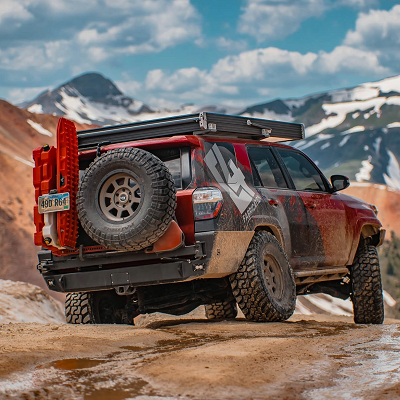




I watched an FJ Cruiser absolutely fly through a whooped-out section of Johnson Valley last summer, suspension soaking up hits that would've rattled teeth loose in a stock vehicle. The owner had dumped close to $15,000 into a full FJ Cruiser long travel suspension setup, and it showed. But here's what he ended up telling me told me: "I use maybe 20% of this capability on 80% of my trips..."
That conversation perfectly captures the long travel dilemma for Toyota FJ Cruiser owners and the long travel dilema more broadly. Long travel suspension is genuinely incredible technology that transforms how a vehicle handles high-speed desert running and big terrain features. It's also expensive, complex, and comes with real tradeoffs especially for daily drivers that most people don't fully understand until they're already committed.
I've helped dozens of FJ owners navigate suspension decisions over the years, and the long travel question always requires an honest assessment of actual usage versus aspirational plans. I never want to push someone into a decision that not only costs a lot but for many can be impractical. Let's break down what long travel really means, who needs it, and whether your FJ is a good candidate for this significant investment.
Long travel suspension increases wheel travel beyond what stock suspension geometry allows. On a stock Toyota FJ Cruiser, you get roughly 7-8 inches of front wheel travel and 9-10 inches in the rear. A proper long travel setup pushes suspension travel to 12-14 inches or more through extended upper and lower control arms that change the suspension arc geometry.

The physics matter here. More wheel travel means the suspension can absorb larger impacts without bottoming out or topping out. At high speeds over rough terrain, that translates to maintaining tire contact with the ground and keeping the chassis stable. It's the difference between a harsh, skipping ride and a smooth, controlled one when you're pushing pace.
However, achieving maximum wheel travel requires more than just bolting on longer control arms. You need coilovers or shocks with longer stroke (10-12+ inches versus 6-7 inches stock), extended axle shafts to handle the increased travel angles, and often widened track width (typically 3.5 inches wider per side) to prevent tires from contacting bodywork at full compression or droop. All those modifications might require cutting and relocating frame mounts and other parts.
It's not something that you can simply undo.
True long travel suspension is a system, not just a collection of parts. That's why kits exist; they bundle the components that work together to achieve specific travel numbers while maintaining drivability.
Before you even look at long travel kit prices or check if you qualify for zero-interest financing (I know it's very tempting), get brutally honest about your driving style and actual usage. I've seen too many FJ owners convince themselves they need long travel based on occasional weekend trips that could be handled by quality mid-travel or even well-tuned stock-replacement suspension.
Track your last 20 off-road trips and ask yourself these questions:
If the honest answer is "rarely" or "never," a long travel kit probably isn't justified by your actual needs.
Think about where you wheel. Long travel shines in specific environments: open desert with long sight lines, high-speed dirt roads with washboard and whoops, jump-filled terrain where suspension articulation matters less than absorption. It's less beneficial in tight technical trails, rock crawling, or low-speed terrain where articulation and approach angles matter more than high-speed damping.
Your skill level and driving style matter too. Long travel suspension rewards aggressive driving and high speeds. If you're a conservative driver who prioritizes capability over speed, or you mostly trail ride at walking pace, you won't even get to use the primary benefits long travel provides.
A quality mid-travel setup from brands like Total Chaos or Icon might serve you better while costing half as much and not having the "no looking back" commitment of a long travel kit.
If you regularly run Glamis, Dumont, Ocotillo Wells, or similar high-speed desert environments, long travel makes sense. These areas feature long stretches of whooped-out sand where speed is limited only by suspension capability.
Pre-running desert race courses is another legitimate use case. Aggressive backcountry exploration where you're carrying speed through washes, hitting embedded rocks at 30+ mph, and launching over crests fits the profile. Rally-style driving on forest service roads also benefits from long travel.
The common thread? Sustained high-speed driving over rough terrain.
Contrary to popular belief, rock crawling doesn't benefit from long travel. Long travel setups reduce low-speed articulation, and the wider track width creates clearance issues.
Overlanding and expedition travel rarely justify it. Most overland routes involve moderate-speed dirt roads, where mid-travel handles conditions better with superior on-road manners.
Weekend warriors seeing 90% street use won't get their money's worth. I've met numerous FJ owners who installed long travel, used it hard a few times, then mostly drove fire roads where the capability sat unused. They paid for performance they rarely accessed while dealing with daily-driver compromises.
Long travel suspension always come in kits, because it is a whole system, so here's a couple of key components in a long travel kit that you need to know to get a grasp of how extensive this mod actually is.
Extended upper control arm and lower control arms (2-4 inches longer than stock) are the foundation. Quality arms use DOM steel tubing or 4130 chromoly. Yes, quality matters the most here; I've seen cheaper HREW arms bend from impacts that DOM arms shrug off.
Ball joint quality separates good from great. Long travel puts extreme loads on joints. Quality upper and lower control arms use heavy-duty uniball-style joints as the standard. Most kits widen the track 3.5 inches per side and include misalignment spacers and grade 8 mounting hardware.
Long travel requires a 10-12+ inch shock stroke versus the 6-7 inch stock stroke. King, Fox, and Icon offer 2.0 x coilover configurations with adjustable damping. Remote reservoir shocks are always an upgrade since it provides better heat management during extended hard use.

Bypass shocks offer the best control but are expensive and complex; most FJ owners don't need them unless they're actually racing. Adjustable limiting straps are also needed to prevent overextension, which can literally obliterate your setup.
Stock CVs max out around 22-25 degrees; long travel pushes to 30+. This is why kits include upgraded extended axle shafts (often 17-4 stainless construction) like the ones from RCV or Longfield. Cheap CVs almost always fail. I've seen them grenade during hard landings.
Front-end geometry changes significantly. You need proper alignment from a shop familiar with modified suspensions. Extended brake lines are also required for increased droop travel; some kits don't include this, so make sure to check.
Bolt-on kits from Dirt King and Camburg aim for maximum capability with minimal fabrication. These kits include all major components designed to work together. Fortunately for you, the 2007-2014 Toyota FJ Cruiser has a ton of support in the aftermarket community.
Kits include upper and lower control arms, coilovers, extended axle shafts, and hardware. But always check product information; some items like bump stops, limiting straps, or extended brake lines might be sold separately.
Bolt-on kits deliver 80-90% of custom capability while keeping costs manageable. For most FJ owners who actually wheel hard, they provide more than enough.
Some of you might've shrugged when I said bolt-on kits keeps costs manageable in the previous paragraph. Get this, full custom costs $20,000-30,000+ with extensive frame modifications. For 99% of owners, the added capability doesn't justify the cost over bolt-on kits.
Semi-custom splits the difference. Start with a bolt-on LT kit, then add upgraded King coilovers or bypass shocks as needs evolve. This spreads costs over time and lets you refine through actual use.
Tire clearance becomes critical when you have a long travel suspension. At full compression and droop, will tires contact bodywork, fenders, or the upper control arm? Many setups require cutting inner fender liners or body mounts.
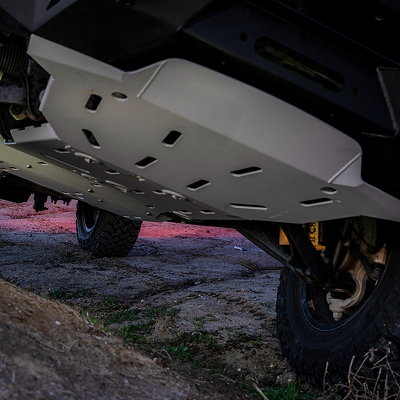
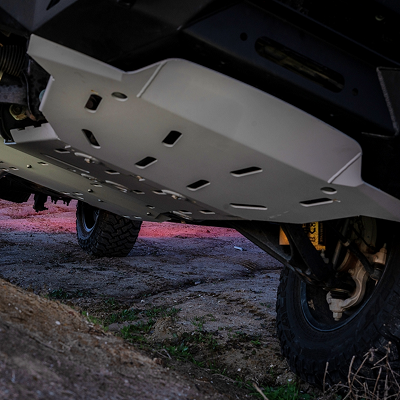
Wider track width (3.5 inches wider per side) affects the turning radius and increases steering effort. Extended brake lines need verification for adequate slack. Long travel upper and lower control arms sit lower than stock, creating vulnerable points, which makes skid plates essential.
Bump stop positioning will affect how you use maximum wheel travel without compromising ground clearance.
Long travel transforms high-speed rough-terrain handling but compromises low-speed ride quality. The firm damping needed for high-speed control makes the ride harsh over small bumps at street speeds. Your FJ will feel rougher around town.
Highway stability often suffers. Long travel geometry prioritizes travel over alignment stability. The vehicle wanders more at interstate speeds. Articulation typically decreases compared to mid-travel setups. Tire wear accelerates 30-50% due to aggressive alignment and geometry changes.
A bolt-on long travel kit costs $5,000-20,000 with labor and everything. Then there's alignment ($200-500), extended brake lines ($200-400), skid plates ($500-1,500), and hydraulic steering ($1,500-3,000). That's just the cost to play.
To keep playing, you need maintenance, and maintenance increases substantially. Uniball joints need greasing every 3,000-5,000 miles. King shocks and other premium brands require rebuilds every 50-100 hours of hard use at $300-600 per corner. Tires cost $300-400 each, and these wear fast, requiring replacements every 20,000-30,000 miles versus 50,000+ on stock.
Not to mention the increased load and stress on your FJ Cruiser engine, which leads to more frequent oil changes, faster wear and tear to gears on the diff and the trans, and generally more fuel since the whole setup will be heavier, especially if you pair it with larger wheels.
We're not even talking about insurance because I'm not even sure how that works, but yeah, it goes up as well.
Mid-travel suspension offers 9-11 inches of front wheel travel, I think it's 70% of the benefit at 40% of the cost. Total Chaos, Icon, and King offer excellent mid-travel solutions for the Toyota FJ Cruiser and Toyota 4Runner platforms.
Consider your total budget. A balanced build with $8,000 in mid-travel and $7,000 in protection often serves real-world use better than dumping everything into a long travel kit alone.
We talked about it all, and if you're still sure about getting yourself a long travel suspension upgrade, here are the top kits that you can get for your FJ Cruiser.
Dirt King Fabrication offers two primary long travel tiers for the FJ Cruiser.
First off, their +2” Long Travel Kit is a perfect blend of on-road and off-road practicality, providing roughly 11-12 inches of wheel travel while maintaining a conservative track width. This system is designed for owners who want a significant boost in suspension cycling without the extreme width that requires fender mods. It utilizes heavy-duty Moog ball joints and "SilentSpin" greaseless bushings in the upper arms, making it one of the lowest-maintenance long-travel options on the market.
The flagship Dirt King +3.5” Long Travel Kit is a race-ready system engineered for the most demanding desert terrain, delivering a full 13.5 inches of travel. The architecture of the kit features 3/16” and 1/8” boxed chromoly plate construction that reduces weight without compromising strength.
These arms are equipped with 1” stainless steel uniballs and 4130 chromoly cups for the outer pivots, replacing the factory ball joints for superior articulation and durability.
The +3.5" kit necessitates front fiberglass fenders to clear up to 35” tires throughout the suspension stroke. The kits include integrated tabbing for limit straps and bypass shocks, and they are compatible with both 2WD and 4WD models. Extended 4340 or 300M axle shafts are available as options.
Like other high-end solutions, these kits are not compatible with KDSS-equipped models and require professional installation to ensure the weld-on limit strap mounts and bump stop strike pads are properly secured.

Coilovers and shocks are also not included.
Shop Dirt King Long Travel Kit
Shop Dirt King +2" Long Travel Kit
The Camburg Trail Series Long Travel Kit is specifically engineered to bridge the gap between daily usability and aggressive off-road performance.
It features boxed lower control arms equipped with 1" uniball pivots at the frame and a Camburg X-joint at the spindle/knuckle for maximum durability. The upper arms use urethane bushings with zerk grease fittings for easy maintenance, though they are optionally upgradeable to billet arms with heims or 1.25" uniballs for those seeking ultimate precision. This setup delivers up to 12 inches of usable wheel travel, providing a significant boost in articulation and high-speed stability.
One critical technical note for the Camburg Trail Series is the specific hardware requirement: it is designed exclusively for non-KDSS equipped models. Furthermore, because it utilizes OEM-style coilover compatibility for its mounting, it requires coilovers with bearing lower rod ends.
This means that factory OEM shocks, TRD Pro shocks, and Bilstein 5100/6112 series shocks will not fit. You must pair this kit with high-performance coilovers from FOX, King, Bilstein (7100+), or Icon that feature the correct bearing ends.
Lastly, it requires cutting, welding, and grinding for frame bump-stop mounts and the removal of factory tabs, typically requiring multi-day professional labor.

Shop Camburg Trail Series Long Travel Kit
Long travel installation isn't a driveway job with a buddy who'll help you out for a pack of beer. Most kits require welding, drilling, and precise bracket alignment. Budget 20-30 hours for experienced mechanics and body work.
Professional installation ($2,000-5,000) makes sense for most owners. A shop experienced with long travel will catch fitment issues and properly torque critical fasteners.
Initial setup requires alignment at a shop familiar with modified suspensions and shock tuning for your driving style. Break-in matters, long travel needs 500-1,000 miles to fully settle before making final adjustments.
Long-term maintenance is critical. Inspect monthly if you wheel hard. Grease uniball joints every 3,000-5,000 miles. Shock rebuilds every 50-100 hours of hard use. Component replacement also happens more frequently; uniball joints need replacement every 30,000-50,000 miles with hard use.
Let's face it, for the majority of Toyota FJ Cruiser owners, long travel is aspirational rather than practical. The capability sits mostly unused while the compromises affect every drive: harsh on-road ride, increased maintenance, reduced fuel economy, and higher tire wear. A quality mid-travel setup serves most real-world use better while costing significantly less.
Be honest about your driving style and actual terrain. If you're not regularly pushing speeds and conditions that overwhelm quality mid-travel suspension, you don't need a long travel kit.
If you are, and you have the budget for the full commitment, including supporting modifications and ongoing maintenance, long travel transforms your FJ into a genuine desert runner, and you'll love it.
The right suspension for your FJ Cruiser matches your actual use, not your imagined use. Long travel is the right answer for a small percentage of FJ owners who genuinely use the capability. For everyone else, there are better ways to spend your modification budget that deliver benefits you'll actually use.